By farrah nagrampa [Wednesday, June 5th, 2013]
Join us next Wednesday June 12 (and on any or all of the following Wednesdays: June 19, June 26, and July 10), for the Mendik Library’s 2013 Summer Research Challenge! Hone your research skills and have some fun (and snacks) at the same time. Get all the details here.
By farrah nagrampa [Monday, May 20th, 2013]
Mendik Library isn’t the only wealth of digital information. There’s even more available through NOVELNY, the New York Online Virtual Electronic Library (a service of the New York State Library). This resource provides over 5,600 databases that include: newspapers, journals, magazines and other periodicals; information on health and business; encyclopedias; and content for children. You can log in with your New York driver’s license or non-driver state ID. Just like Mendik, it’s YOUR library – check it out!
By farrah nagrampa [Thursday, May 16th, 2013]
May 17 marks the anniversary of the unanimous 1954 Supreme Court decision in Brown v. Board of Education. Prior to Brown, many parts of the United States permitted segregation in public education based on the principle of ‘separate but equal,’ a doctrine based on the longstanding decision in Plessy v. Ferguson. Brown brought together cases from four different states challenging the validity of that doctrine.
The court considered whether segregation was consistent with the framers’ intent in the Fourteenth Amendment but found little support there for overruling Plessy. In order to forge a unanimous opinion, the justices rested their decision on the critical role education plays in determining personal opportunity and development, finding that racial segregation generated irreversible feelings of inferiority in black children. The court concluded that segregated schools were inherently unequal and abandoned the premise that ‘separate but equal’ did not cause harm or stigmatization.
Further resources:
Landmark Supreme Court Cases: A Reference Guide, Donald E. Lively (Greenwood Press, 1999).
Brown v. Board of Education: Caste, Culture and the Constitution, Robert J. Cottrol (University Press of Kansas, 2003).
Education Law Stories, Michael A. Olivas (Foundation Press, 2007).
Encyclopedia of the Supreme Court of the United States, David S. Tanenhaus (Macmillan Reference USA, 2008).
By farrah nagrampa [Monday, May 6th, 2013]
Yesterday was Cinco de Mayo (the 5th of May), and we hope you all found at least some time to celebrate and enjoy the day amidst all the hard-core studying.
Often mistaken for a celebration of Mexican independence, Cinco de Mayo commemorates the Mexican army’s victory in the Battle of Puebla during the Franco-Mexican War. On May 5, 1862, General Lorencez and 6,000 French troops marched towards Puebla, Mexico. Greatly outnumbered, the Mexicans fought and improbably defeated the French army at Puebla.
Now, Cinco de Mayo is widely celebrated in the United States as a celebration of Mexican culture and heritage. Even Congress has officially recognized the holiday, passing a number of resolutions entitled “Recognizing the historical significance of the Mexican holiday of Cinco de Mayo.” For example, S. Res. 128, 111th Cong. (2009), H. Res. 230, 111th Cong. (2009), and H. Res. 347, 110th Cong. (2007). And this year, President Obama issued a formal statement that read, in part, “[o]n Cinco de Mayo we celebrate the contributions and heritage of Mexican Americans and we recognize the strong cultural, familial, and economic ties that bind the United States and Mexico.” Interestingly, Cinco de Mayo is not considered a public holiday in Mexico and is not widely celebrated in Mexico.
Check out these links from the Law Library of Congress for more information.
By farrah nagrampa [Friday, May 3rd, 2013]
An early congratulations to the graduating class of 2013! May 19th will mark New York Law School’s 121st Commencement Exercises. This year’s ceremony will be held at Avery Fisher Hall at Lincoln Center. Did you know that in 1899 the graduation ceremony was held at Carnegie Hall?
Commencement ceremonies give us time to celebrate our new graduates and time to honor all the Law School’s previous graduates. It’s always fun to view this slice of our history by looking back at our Commencement Exercises Programs. The Library has created two exhibits of NYLS Commencement Programs spanning three centuries! We invite you to take a quick break and visit both if you can!
- In the Library’s Rare Book Room display case (L302) you’ll find programs from 1894, 1900, 1904, 1912, 1950, 1961 and more . . . .
- In the display case outside the Matasar Commons on W2 (on the way to the Event Center) you’ll find programs from 1899, 1913, 1975, 1991 and more . . . .
Enjoy the Law School’s rich history!
By farrah nagrampa [Friday, April 19th, 2013]
Continuing with its A Billion Acts of Green® movement, a “people-powered campaign to generate a billion acts of environmental service and advocacy . . .” that began in 2011, the folks at the Earth Day Network are now looking to reach 2 Billion Acts of Green. The total reported as of the morning of April 19, 2013 was 1,019,860,805 (and counting).
One easy Act of Green you could pledge would be to turn off the library study table lamps and carrel lights whenever you leave. Or, you could use the stairs instead of the elevators between floors. We will thank you and so will the Earth.
Another suggestion: By drinking your coffee, tea, or other beverage from a spill-proof, reusable mug, you can transform a single Act of Green into an ongoing one, helping continually to reduce the volume of plastic, Styrofoam, and paper cups piling up in landfills or requiring energy for recycling. At the same time, you’ll be complying with the Library’s food and drink policy and earning our thanks!
If you don’t have a spill-proof mug, pick one up at the Circulation Desk for $3.00. Although we already sell these mugs at a loss, for every one purchased through the end of this semester’s exam period librarians will contribute $.50 to Earth Day Network (www.earthday.org/), which works with over 22,000 partners in 192 countries to broaden, diversify and mobilize the environmental movement.
For complete information about Earth Day, visit Earth Day Network.
By farrah nagrampa [Wednesday, April 10th, 2013]
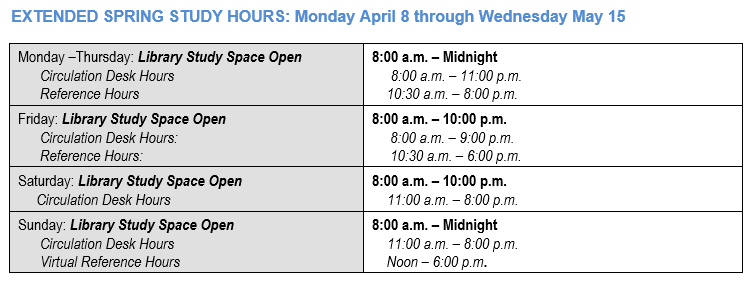
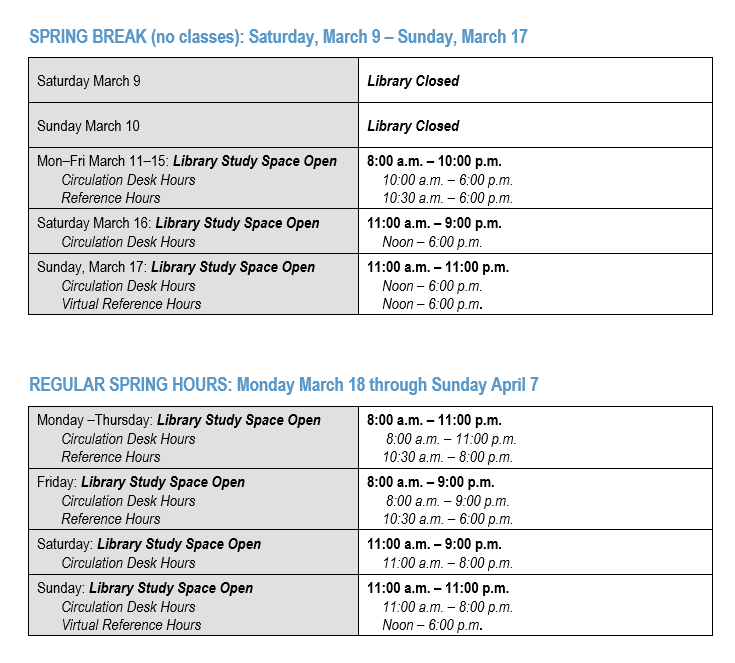
Effective Monday April 15, all study areas and computer labs in the Mendik Library will remain open late night and early morning hours. The late hours extend to 2 a.m. every day, and the Library space reopens at 7 a.m. every morning. This Study Hall schedule will remain in effect through the end of the exams period.
During Study Hall all areas behind the Circulation Desk, including the Reserve Collection and the Reserve Reading Room, will close at 11 p.m. on Monday through Thursday, and 10 p.m. on Friday, Saturday and Sunday. The Library opens for business at 8 a.m. on weekdays, and 9 a.m. on weekends.
During late night and early morning Study Hall hours there are no librarians on duty; security guards patrol Library rooms and study areas. All Circulation transactions, including borrowing and return of books, as well as charge-out and charge-in of Reserve materials, must be completed by regular closing time. Policies regarding food, drink and quiet study remain in effect.
Late and early Study Hall is for NYLS students only; you’ll need your NYLS OneCard ID to stay at closing time, and to enter the Library after closing. Please have your ID ready to show the guard.
Students will be required to leave the Mendik Library when the facility closes at 2 a.m. Study areas elsewhere on campus remain open 24 hours.
By farrah nagrampa [Tuesday, April 9th, 2013]
It’s that time of year again! Are you looking for tax forms? You can find federal forms on the IRS site here.
The IRS also provides a list of free resources to help you file your taxes.
If you are looking for New York forms, find them here. If you need forms from other states, there are links to all state tax forms from the Federation of Tax Administrators. The Journal of Accountancy has also compiled a list of additional tax filing resources for the year 2012.
By farrah nagrampa [Monday, March 25th, 2013]
On March 18, 1963, the Supreme Court handed down the decision in Gideon v. Wainwright, a case that made significant changes to the face of criminal law in the United States.
Charged with breaking and entering into a Florida pool hall, Clarence Earl Gideon could not afford an attorney. After being convicted and sentenced to five years imprisonment, he appealed and asserted that his conviction was unconstitutional because the trial court refused to appoint counsel. The Supreme Court’s unanimous decision, written by Justice Hugo Black, found that the Sixth Amendment gives criminal defendants the right to counsel when charged with a serious offense, even if they cannot afford it. Gideon was subsequently retried and acquitted.
In ruling that states are required to provide attorneys to indigent criminal defendants, the Supreme Court effectively created the public defender system that is today accepted as an integral part of the legal community.
Further reading:
Gideon’s Trumpet (Book)
Gideon’s Trumpet (Movie)
Kyung M. Lee, Reinventing Gideon v. Wainwright: Holistic Defenders, Indigent Defendants, and the Right to Counsel, 31 Am. J. Crim. L. 367 (2004). (Article mentions The Bronx Defenders.)
Bruce R. Jacob, Memories and Reflections about Gideon v. Wainwright, 33 Stetson L. Rev. 181 (2003). (The author is the former Florida Assistant Attorney General who argued the case before the United States Supreme Court.)
The Right to Counsel and Privilege Against Self-Incrimination: Rights and Liberties Under the Law
By farrah nagrampa [Wednesday, March 20th, 2013]
Happy April Fool’s Day from the Mendik Library! As a springtime treat, here’s an easy opportunity to be entered into a drawing to WIN valuable study aids, texts and other prizes.
Click here to access the April Fool’s Day Info Hunt (works best with Internet Explorer). Each slide includes one question (there are only 6) and easy, step-by-step instructions. Press Enter to reveal each step. Click here to access an answer sheet, or pick up a copy at the Reference Desk. Drop your completed answer sheet in the Raffle Drum at the Reference Desk or e-mail it to reference@nyls.edu by 5:00 PM on Thursday, April 4. The drawing will take place outside the library entrance on April 4 at 5:40 PM. You need not be present to win, but an additional entry form will be added for each student who does attend!
Among the titles the winners will choose from are:
Acing Criminal Procedure
Federal Criminal Practice: A Second Circuit Handbook
Foundations of Labor and Employment Law
Foundations of Tort Law
Leading Constitutional Cases on Criminal Justice
Legal Writing: Ethical and Professional Considerations
Plain English for Drafting Statutes and Rules
Property: Examples and Explanations
Questions & Answers: Business Associations
Questions & Answers: Civil Procedure
Questions & Answers: Contracts
Questions & Answers: Criminal Law
Questions & Answers: Criminal Procedure
Questions & Answers: Torts
Understanding Islamic Law